

Factoring is a foundational skill in algebra and higher-level mathematics. Knowing how to factor expressions simplifies problem-solving, makes equations solvable, and improves understanding of mathematical structure. From basic polynomials to quadratic equations, factoring allows you to rewrite expressions as a product of simpler terms, making complex math more manageable.
This article covers how to factor polynomials, trinomials, quadratic equations, and general polynomial expressions. Each section breaks the process into actionable steps, provides examples, and explains the reasoning behind each method. Factoring is not only a tool for solving algebra problems but also a skill that strengthens overall mathematical fluency.
By the end of this guide, you’ll confidently factor a variety of expressions and understand which methods apply in each situation. Whether you are a high school student, college learner, or adult brushing up on algebra, these techniques will make factoring more intuitive.
Why Factoring Is Important in Mathematics
Factoring simplifies complex expressions and enables problem-solving in algebra, calculus, and beyond. Without factoring, solving equations, finding zeros of functions, and simplifying expressions becomes cumbersome. In applied mathematics, factoring is essential for modeling problems, optimizing functions, and even in physics or engineering calculations.
Mastering factoring also strengthens logical reasoning and pattern recognition. Recognizing common factors, quadratic structures, or trinomial patterns allows students to approach problems systematically, reducing errors and improving confidence. Factoring is not just a technique—it’s a lens for seeing mathematical relationships.
How to Factor Polynomials
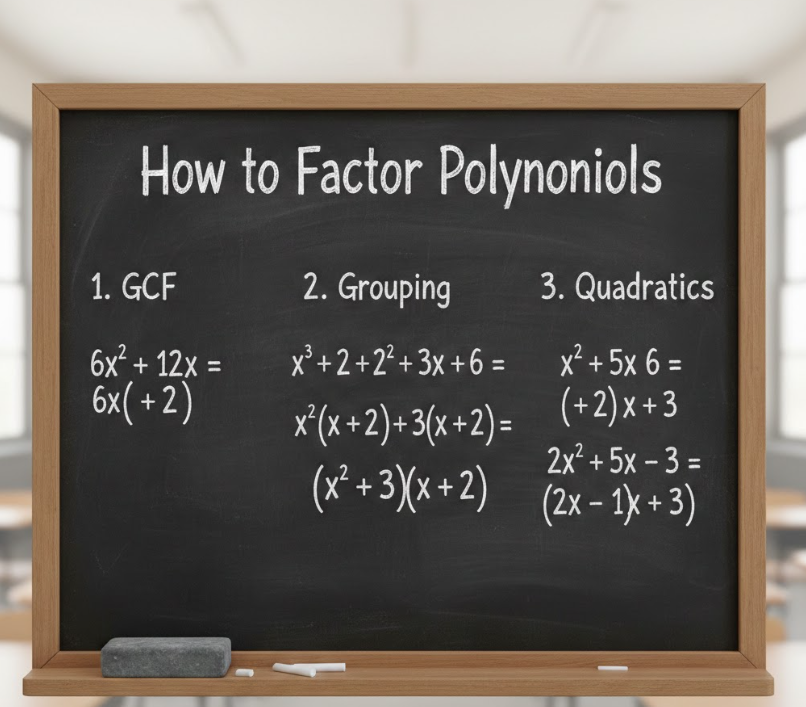
Understanding Polynomial Factoring
Learning how to factor polynomials involves identifying patterns, common factors, and structure within algebraic expressions. Polynomials are expressions made up of multiple terms connected by addition or subtraction, and factoring them rewrites them as products of simpler polynomials or monomials. Factoring polynomials is essential for solving equations, simplifying rational expressions, and performing calculus operations like integration.
Polynomial factoring can vary in complexity from simple expressions with common factors to higher-degree polynomials that require grouping, special formulas, or advanced strategies. Mastery involves understanding both mechanical procedures and pattern recognition.
Step-by-Step Polynomial Factoring Techniques
• Identify the greatest common factor (GCF)
Finding the GCF ensures you simplify the polynomial first, reducing all coefficients and variables uniformly before applying more complex methods. This step is foundational and prevents errors in later stages.
• Use factoring by grouping for four-term polynomials
Grouping terms strategically can reveal common binomial factors. This method involves splitting the polynomial into pairs and factoring each separately, then factoring the common binomial factor.
• Apply special formulas (difference of squares, perfect squares)
Recognizing patterns like a2−b2=(a−b)(a+b)a^2 – b^2 = (a-b)(a+b)a2−b2=(a−b)(a+b) or (a+b)2=a2+2ab+b2(a+b)^2 = a^2 + 2ab + b^2(a+b)2=a2+2ab+b2 simplifies factoring without trial-and-error, making calculations faster and more accurate.
• Check for repeated factors
Some polynomials factor further into smaller polynomials after initial factoring. Always re-examine the expression to ensure complete factorization.
• Use synthetic or long division for higher-degree polynomials
When dealing with cubic or quartic polynomials, division techniques help identify linear factors, reducing the problem to lower-degree expressions.
• Verify by multiplication
Multiplying factors to reproduce the original polynomial confirms accuracy. This step prevents mistakes in more complex problems.
Also Read:- How to Share Location on iPhone: The Complete Practical Guide
How to Factor Trinomials
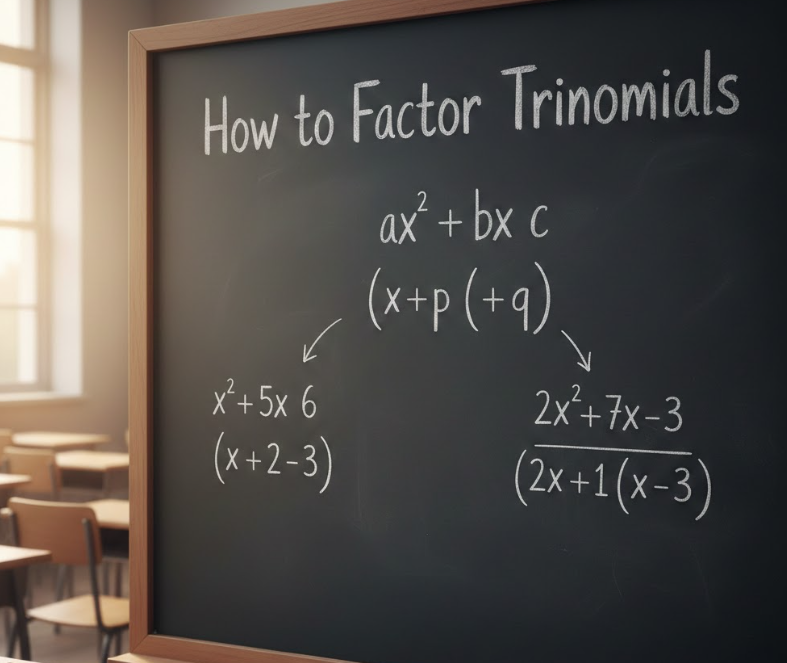
Learning how to factor trinomials focuses on expressions with three terms, usually in the form ax2+bx+cax^2 + bx + cax2+bx+c. Trinomial factoring simplifies equations and is critical for solving quadratic problems. Identifying the right pair of numbers that satisfy both the sum and product of coefficients is central to trinomial factoring.
Trinomial factoring involves recognizing patterns, using trial and error, and understanding divisibility. It’s a bridge between simple monomial factoring and more complex quadratic equation solving.
Step-by-Step Trinomial Factoring Process
• Identify the coefficients a,b,ca, b, ca,b,c
Recognizing which terms correspond to ax2,bx,cax^2, bx, cax2,bx,c sets up proper factoring and avoids errors in sign or combination.
• Determine factor pairs of acacac
Multiplying aaa and ccc helps identify pairs of numbers whose product equals acacac and whose sum equals bbb. This step is crucial for decomposition.
• Split the middle term
Rewrite the middle term as two terms based on factor pairs. This prepares the polynomial for factoring by grouping.
• Group terms into two pairs
Each pair is then factored separately, creating binomial factors that will multiply to recreate the trinomial.
• Factor out common binomial
After grouping, the common binomial factor is factored out, yielding the final factored form.
• Check by expansion
Expanding the factors ensures that the trinomial multiplies back correctly, verifying that no mistakes were made.
Also Read:- How to Attract Birds: A Complete, Science-Backed Guide for Your Yard and Garden
How to Factor Quadratic Equations
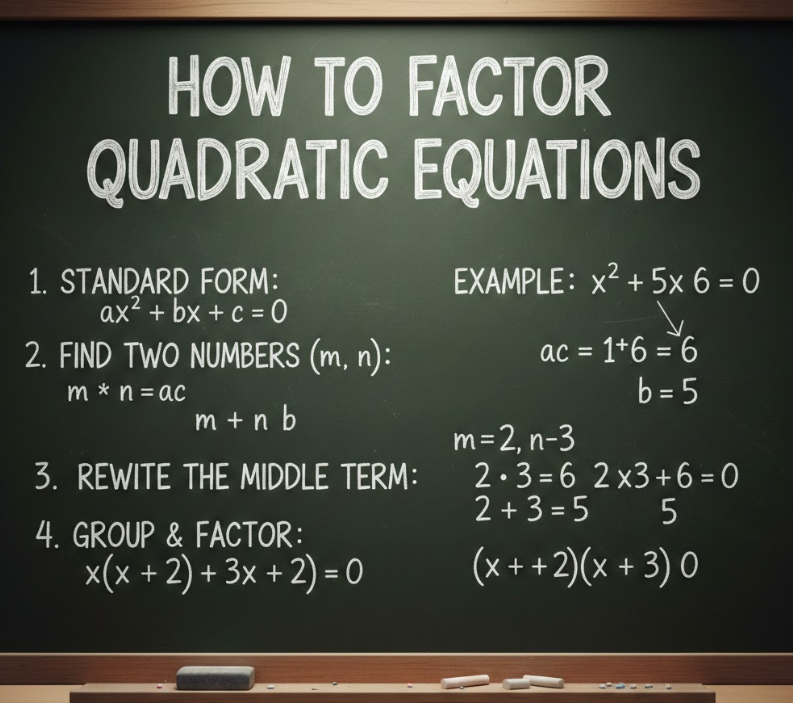
Learning how to factor quadratic equations involves rewriting equations of the form ax2+bx+c=0ax^2 + bx + c = 0ax2+bx+c=0 into products of two linear factors. Factoring quadratics is a fundamental step in solving equations and is widely used in algebra, physics, and engineering.
Quadratic factoring relies on identifying suitable factor pairs, recognizing perfect square trinomials, or using the difference of squares. Factoring enables solving for the variable without resorting to the quadratic formula every time.
Step-by-Step Quadratic Factoring Techniques
• Check if the equation is factorable
Some quadratic equations have integer solutions, making them easier to factor. Identify whether factoring is possible before applying other methods.
• Divide out any common factors
Simplifying coefficients before factoring reduces errors and makes computations easier.
• Decompose the middle term
Use factor pairs to split the linear term, preparing for grouping.
• Group terms and factor each group
Factor pairs of terms separately, then identify the common binomial factor.
• Write in standard linear factor form
Express as (dx+e)(fx+g)=0(dx + e)(fx + g) = 0(dx+e)(fx+g)=0 to solve for the variable using the zero-product property.
• Verify solutions
Substitute values back into the original equation to ensure correctness and avoid extraneous solutions.
Also Read:- How to Make a Slip Knot: Step-by-Step Guide for Crochet, Knitting & Bracelets
How to Factor a Polynomial
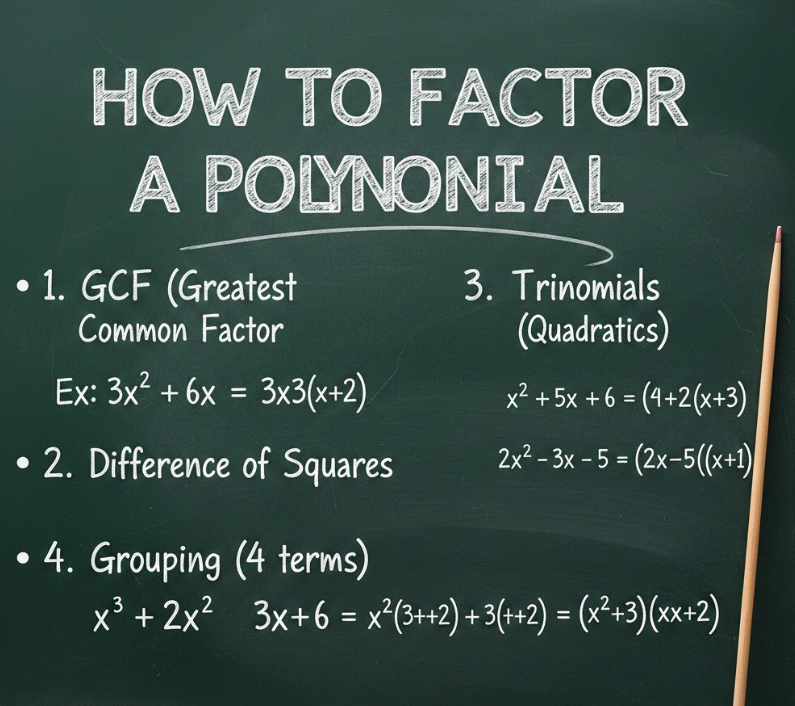
Learning how to factor a polynomial involves understanding commonalities across different polynomial types. This includes monomials, binomials, trinomials, and higher-degree polynomials. Factoring reduces complexity, making evaluation, simplification, or solving more straightforward.
Polynomial factoring combines multiple techniques, such as GCF, grouping, special formulas, or division. Understanding when to use each method ensures efficiency and accuracy.
Key Strategies for Factoring Polynomials
• Look for greatest common factors first
Always begin by factoring out the largest shared term. This simplification often reveals additional factoring opportunities.
• Identify patterns and formulas
Spotting differences of squares, cubes, or perfect square trinomials accelerates the process.
• Use grouping for multi-term polynomials
Split into pairs or triplets to factor strategically, especially when no obvious common factor exists.
• Apply synthetic or long division for complex polynomials
Higher-degree polynomials benefit from division to reduce degrees and reveal factors.
• Combine multiple techniques when needed
Some polynomials require both grouping and special formulas for full factorization.
• Verify by multiplying factors
Check by expansion to confirm accuracy and completeness.
Also Read:- How to Make a Paper Dart: The Ultimate Guide
Conclusion
Mastering how to factor is essential for algebra proficiency. Whether factoring polynomials, trinomials, quadratic equations, or complex expressions, understanding techniques, patterns, and verification methods ensures success. Factoring improves problem-solving, reduces errors, and prepares learners for higher-level mathematics.
Frequently Asked Questions
What does “factor” mean in math?
Factoring is rewriting an expression as a product of simpler expressions or numbers.
Is factoring always possible?
Not all polynomials have integer factors; some require the quadratic formula or numerical methods.
Why is factoring important?
Factoring simplifies equations, aids in solving for variables, and improves understanding of algebraic structure.
Visit For More Information Go To entrepreneurideas